Skip to content

Pre-grade before you pay a grader

AI card grading: know the likely PSA grade before you submit

PSA paused its cheapest tiers in June 2026, so a single submission now starts around $80 per card plus shipping. SnapCard scans the front and back of a raw card, estimates its grade on the PSA 1–10 scale, and shows what that grade has recently sold for, so you only pay to grade cards that will earn it back.

An AI card grading app photographs a raw card, checks centering, corners, edges and surface, and returns an estimated grade. SnapCard expresses that estimate on the PSA scale and pairs it with recent sold prices for the same card at that grade, which is the number that decides whether a submission makes sense.

Get a grade estimate

4.6 ★ on the App Store from 921 ratings

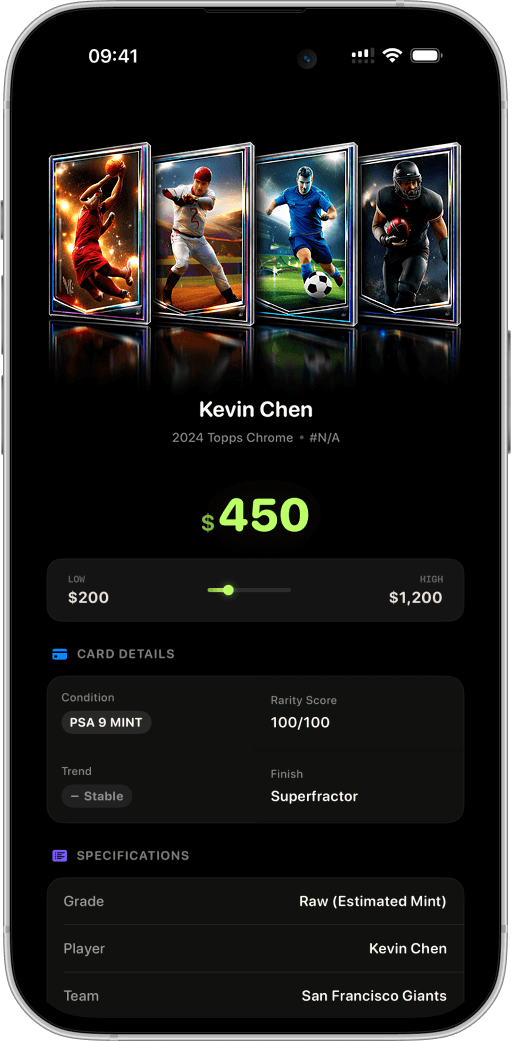
SnapCard AI card grading screen showing a PSA-scale condition estimate for a raw sports card

How the grade estimate works

Three photos and about ten seconds. No account, no cert number, no submission form.

  1. 1

    Scan the front, then the back

    Lay the card flat in good light and let the app find the edges. The back photo is optional but improves the read on corners and edge wear, which is where most PSA 9s lose their 10.

  2. 2

    Get a PSA-scale estimate

    The AI returns a condition estimate from PSA 1 (Poor) to PSA 10 (Gem Mint), with the centering, corners, edges and surface findings that drove it. Treat it as a second opinion, not a guarantee.

  3. 3

    Compare raw vs graded sales

    The same screen shows recent sales for the card raw and at nearby grades, so you can see whether a PSA 9 adds $8 or $180 before you commit to the fee.

What an AI grader actually checks

Every grading company scores the same four things: centering, corners, edges and surface. A human grader does it with a loupe and years of reference cards; the AI does it by comparing your photos against the patterns that separate a Gem Mint corner from one with a touch of white. SnapCard reports the estimate on the PSA scale because that is the scale most sold-price data is quoted in, which makes the raw-versus-graded comparison meaningful.

The estimate is only as good as the photos. Glare hides surface scratches, a tilted card fakes off-centering, and a dark room softens the corners. The app guides the capture, but a card photographed under a lamp will always read better than one photographed on a couch.

The four grading criteria and what typically costs a grade
CriterionWhat graders look forCommon PSA 10 killer
CenteringBorder width left/right and top/bottomWorse than roughly 55/45 on the front
CornersSharp points with no whitening or dingsA single soft or frayed corner
EdgesClean, uniform cut with no chippingChipping on dark-bordered cards
SurfaceNo scratches, print lines, dents or stainsPrint lines and light scratches under glare

Is it worth grading? The arithmetic

A submission is worth it when the graded sale price minus the grading fee, shipping both ways and the marketplace fee exceeds what the card sells for raw. With a Regular-tier fee around $80, that rules out most modern base cards even at PSA 10, and it rules in far fewer PSA 9s than collectors hope.

Collectors often use a 3x rule of thumb: only submit when the expected graded value is at least three times the all-in cost of grading. SnapCard does not enforce a rule; it shows the raw price, the graded prices and the estimate side by side so the decision is yours and made with numbers instead of hope.

A grade estimate is not a grade

PSA, BGS, SGC and CGC assign the grade that appears on a slab. SnapCard's estimate is an AI opinion that can differ from the professional result, especially on surface issues that photographs hide. Use it to decide what to submit, not to price a raw card as if it were already graded.

Reading cards that are already slabbed

Point the scanner at a graded card and it reads the label as well as the card: the grading company, the grade and the certification number. SnapCard recognises PSA, BGS, SGC and CGC slabs, so a graded pickup goes into your collection with its grade attached and its value pulled from graded sales rather than raw ones.

That matters most for verifying a purchase. If a listing says PSA 10 and the label the scanner reads says PSA 9, you know before the return window closes.

Which cards are worth pre-grading

The pre-grade pays for itself on cards where the gap between grades is wide: rookie cards of active stars, low-numbered parallels, vintage in unusually clean shape, and Pokémon cards from sets where PSA 10 populations are small. It is least useful on modern base cards, where even a PSA 10 rarely clears the fee.

  • Rookie cards where PSA 10 sells for several multiples of PSA 9
  • Numbered parallels and refractors with low graded populations
  • Vintage cards you suspect are better than the eye suggests
  • Pokémon and other TCG chase cards from recent sets
  • Any card you are about to list as "gem mint" without a grade behind the claim
PSA-scale estimate
1–10
Slab labels read: PSA, BGS, SGC, CGC
4
Sold-price sources
5
Accounts or sign-ups required
0

Questions about AI card grading

How accurate is AI card grading?

Accurate enough to sort a pile into submit and do-not-submit, not accurate enough to replace a slab. Centering and corners photograph well and are estimated reliably; surface flaws depend on lighting and are the most common reason an estimate and a professional grade differ by a point.

Does SnapCard grade on the PSA scale or the BGS scale?

Estimates are expressed on the PSA 1–10 scale, because most sold-price data is quoted that way. When you scan an existing slab, the app reads PSA, BGS, SGC and CGC labels as they are printed.

How much does PSA grading cost in 2026?

As of mid-2026 PSA's Regular service starts around $80 per card after the lower-priced tiers were paused, with faster tiers costing more. Add shipping both ways and the marketplace fee on the eventual sale when you work out whether a submission pays.

Can the app grade a card that is already in a slab?

It reads the slab rather than re-grading the card: company, grade and cert number come off the label, and the value shown is drawn from sales of that card at that grade.

Do I need an account to use the grade estimate?

No. SnapCard has no sign-in. Download it, scan a card and the estimate appears with the pricing. Pro unlocks unlimited scans and the full condition analysis; the app is free to download.

What should I do if the estimate says PSA 8?

Look at the graded prices on the same screen. If a PSA 8 of that card sells for less than the raw price plus roughly $100 in fees and postage, keep it raw or sell it raw. If it is a card where an 8 still carries a premium, the estimate has told you the submission is reasonable.

Grade the ones worth grading

Scan the card, read the estimate, compare the graded sales, and send in only the cards that will earn back the fee.

Download SnapCard free