Skip to content

An honest comparison

Can ChatGPT identify sports cards and tell you what they are worth?

Mostly yes on the first part and not reliably on the second. A general assistant reads the photo well enough to name the player and usually the set. It gets shakier on the exact version, and it has no record of what the card sold for last week.

ChatGPT and similar assistants can usually identify the player and often the set from a card photo, but they do not have live sold-price data, cannot reliably tell a base card from a parallel, and may give a different grade each time you ask. A purpose-built scanner like SnapCard matches the card to a catalog, shows recorded sales, and applies one condition rubric every time.

Try a purpose-built scan

4.6 ★ on the App Store from 921 ratings

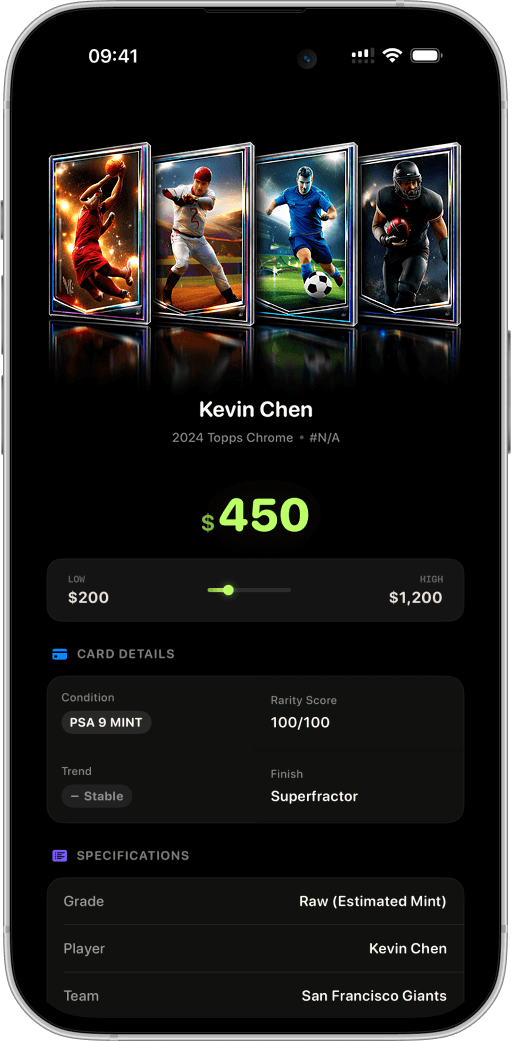
Side-by-side comparison of a chat assistant's card answer and SnapCard's sold-price result for the same card

What happens when you ask an assistant about a card

Try it with a card you already know; the pattern below is what collectors tend to see.

  1. 1

    It names the player and the year

    Upload a photo and ask what it is. The model reads the name, the team logo and the design, and usually lands on the right player and brand. For a well-known card, say a 2018 Panini Prizm Luka Doncic, it often gets the set too.

  2. 2

    It guesses the version

    Ask whether it is a base card or a parallel and the answer gets less certain. A Silver Prizm and a base Prizm differ by a holographic finish that photographs like glare, and a refractor looks like plain chrome under most lighting.

  3. 3

    It quotes a price from memory

    Ask what it is worth and you get a number. The figure comes from training data or a web search of asking prices, not from completed sales. Ask again tomorrow and the number can move.

Where a general assistant does well

Image-capable models are good at reading text and recognizing designs, and a trading card is mostly both: player, team, brand, year and card number are printed right on it. An assistant is also a patient tutor. Ask what a refractor is, why 1989 Upper Deck matters, or how PSA and BGS differ, and you get a clear answer in plain English.

That makes it the right tool for learning the hobby's vocabulary and for a first pass on an unfamiliar card.

Where it falls short on numbers

Value is a lookup, not a reasoning task. The current price of a card is whatever copies sold for in the last few weeks, and no general model carries that table. Asked for one, it answers from memory, from a search of listings that may never sell, or from a plausible estimate. In practice the figure can be months stale, and the model sometimes describes a parallel the set never included.

Grading has the same problem in a different shape. Professional graders score centering, corners, edges and surface against a fixed rubric. An assistant has no rubric, so asking it to grade the same photo twice can return a 7 one time and a 9 the next. And nothing is saved for the next card.

General AI assistant versus a purpose-built card scanner
TaskChatGPT, Gemini, Google LensSnapCard
Identifies the playerUsuallyYes, matched against a card catalog
Identifies the exact set and parallelSometimes; parallels are often missedYes, with the parallel named
Live sold pricesNo; quotes remembered or asking pricesYes, from eBay, Goldin, Heritage, PWCC and Pristine
Consistent grade estimateNo fixed rubric, so results varyOne rubric on the PSA 1 to 10 scale, every scan
Saves to a collectionNoYes, with binders, purchase price and portfolio value
Free to tryYes, with limits on the free tierFree to download; Pro is $7.99 a week or $39.99 a year

What a purpose-built scanner does differently

A card scanner does not reason about the photo; it matches it against a catalog of sports and TCG cards. That is how it separates a base card from a Silver Prizm or a refractor: they are distinct catalog entries with distinct sales histories, not a judgment about shine. Once matched, it pulls recorded sales for that exact card.

The condition estimate applies the same four criteria on every scan and reports on the PSA 1 to 10 scale. The result goes into a collection with a purchase price, a binder and a running portfolio value, synced over iCloud on Pro. No account is needed; scanning does need a connection.

Use both, for different questions

Ask an assistant when the answer is made of words: what a parallel is, whether a player's rookie year was 2019 or 2020, how to ship a card safely. Use a scanner when the answer is a number: what it sold for, what grade it might get, what the binder is worth.

How to check an AI answer before you trust it

Whichever tool gave you the number, a two-minute check catches most errors.

  • Search the card name plus the parallel on a marketplace and filter to sold listings; asking prices are not values.
  • Confirm the parallel exists on the set's checklist; models sometimes invent a numbered version.
  • Check whether the suggested grade has sales behind it; a grade with no sales is a guess.
  • Photograph the card again in different light; if the answer changes, it was not anchored to anything.
Sold-price platforms behind every scan
5
Condition rubric, applied the same way each time
1
Grading companies whose slabs the app reads
4
Sign-ins, for the scanner or the collection
0

Questions about AI assistants and card values

can chatgpt identify sports cards

Usually, yes, for the player, brand and year. It is less reliable on which parallel you hold, because a Silver Prizm and a base card differ only in finish, and finish photographs poorly.

can chatgpt tell me what my card is worth

It will give you a number, but that number is not drawn from recent completed sales. It may be a remembered figure, an asking price, or an estimate. Treat it as a starting guess and verify it against sold listings or a scanner that shows recorded sales.

can chatgpt grade my card

It can describe visible flaws, such as a soft corner or off-center borders, and suggest a grade. It does not use a fixed rubric, so the suggestion can change between attempts. A professional grader, or a scanner with a consistent condition estimate, gives you something repeatable.

can chatgpt value pokemon cards

Same pattern as sports cards: it identifies the Pokémon, the set symbol and often the card number, then estimates a price from memory. Pokémon prices moved sharply between 2024 and 2026, so a remembered figure is often out of date. SnapCard scans Pokémon, Magic and Yu-Gi-Oh! cards and shows recent sales.

does google lens work for card values

Google Lens is good at finding visually similar listings, which helps with identification. The prices it surfaces are mostly active listings, so they show what sellers hope for rather than what buyers paid. Check sold results before relying on a Lens price.

is chatgpt accurate at grading cards

It is not designed for it. Grading depends on details a phone photo flattens, and on a rubric applied the same way across thousands of cards. A general model has neither, so its grade is an impression. Use it to learn what graders look for, not to decide a submission.

Ask the assistant, then scan the card

Keep using ChatGPT for the questions. For the price and the grade, scan the card and read the sales.

Download SnapCard free