Skip to content

Sold prices, not book value

A sports card price guide built from what cards actually sold for

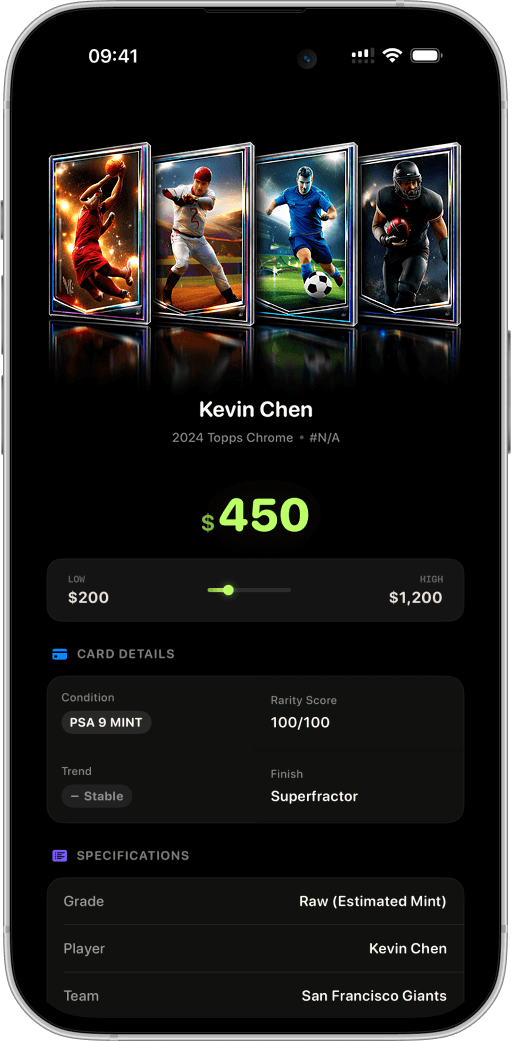
A printed price guide lists a number somebody typed months ago. SnapCard lists the sales. Scan a card and the app identifies it and pulls recent sold results from eBay, Goldin, Heritage, PWCC and Pristine. You see the average, low and high plus a demand trend.

A sports card price guide tells you what a card is worth by listing what copies have sold for. SnapCard builds that guide from recorded sales on eBay, Goldin, Heritage, PWCC and Pristine rather than from a printed book value. Scan a card and the app shows its average, low and high sale, plus whether demand is rising, falling or stable.

Scan a card for its price

4.6 ★ on the App Store from 921 ratings

SnapCard sports card price guide screen listing recent sold prices with the average, low and high for a scanned card

Scan instead of typing a search

Typing "2023 Topps Chrome Elly De La Cruz refractor" into a search box takes a minute and still misses the parallel. Pointing the camera takes seconds and gets it right.

  1. 1

    Point the camera at the card

    Hold the phone over the card and the app frames it. Player, set, year, card number and parallel are identified from the image, so there is nothing to type and no listing title to misspell.

  2. 2

    Read the sales, not the listings

    The result screen lists recent sold results with the platform each came from. Auction results and fixed-price sales are marked, and graded copies are kept apart from raw ones.

  3. 3

    Check the trend before you act

    Under the average, low and high sits a demand label: Rising, Falling or Stable. A rising card with a narrow low-to-high spread is a safer buy than a falling card with the same average.

Asking prices and sold prices are different numbers

A listing price is what a seller hopes to get. A sold price is what a buyer paid. On any marketplace the two routinely differ by 30 to 50 percent. Unsold listings sit at hopeful prices for months, while the sales that clear happen lower and faster. Every price SnapCard shows comes from a completed transaction, which is why it can be lower than an active search suggests.

A card that trades twice a year has no meaningful asking price, only the two results that closed. The guide shows those sales with their dates, so you can judge how thin the data is.

Why the same card has five different prices

Search for a 2018 Panini Prizm Luka Doncic rookie and the results run from under $50 to over $1,000 as of 2026, all for one card number. Nothing is wrong with the data. The card exists as a base version, a dozen parallels and every grade from raw to PSA 10. Each combination is its own market, which a single book value cannot describe.

  • Grade: a PSA 10 of a modern rookie commonly brings 3 to 8 times the raw price as of 2026, while a PSA 9 often adds little
  • Parallel: base, refractor, numbered and one-of-one versions share a card number and nothing else
  • Sale format: an auction finds the market price on the day; a fixed-price sale shows what one patient seller accepted
  • Timing: a rookie can move 40 percent in a month around a playoff run, an injury or a trade
  • Platform: a major auction house often brings more than a marketplace for the same card, because the bidders are different

Where the prices come from and what each one tells you

SnapCard records the platform behind every sale, because the source changes how you should read the number. Five sources feed the guide: eBay, Goldin, Heritage Auctions, PWCC and Pristine Auction. A $300 hammer price and a $300 Buy It Now are not the same evidence.

Sales that closed through an accepted offer on eBay often display the listed price rather than the amount paid. That is one more reason a single fixed-price result should never anchor a valuation.

Three kinds of sale and how to read each
Source typeHow the price is setWhat it tells you
Auction house (Goldin, Heritage, PWCC, Pristine)Competitive bidding to a hammer price, usually with a buyer's premium addedThe ceiling for a card on a given day; strongest evidence for graded and high-end cards
Marketplace auction (eBay)Bidding over several days, often ending late at nightThe clearing price for common and mid-range cards; low-traffic endings can run cheap
Marketplace fixed price (eBay Buy It Now)Seller asks, buyer accepts, sometimes after an offer below the askWhat a buyer paid to skip the wait; tends to sit above auction results

How to read a comp

A comp, short for comparable sale, is a recent sale of the same card in the same condition. Three comps from the last 30 days are worth more than thirty from last year. In the average, low and high SnapCard shows, the low is usually a damaged copy or a badly timed auction. The high is usually a bidding war. The average is where most sales land, so sell near the average and buy near the low.

The trend label is the piece a book value cannot give you. Rising means recent sales are closing above earlier ones, Falling means the opposite, and Stable means the card trades in a narrow band. A stable card with 20 or more comps is the easiest card in the hobby to price.

What the guide will not tell you

It cannot price a card that has never sold, and it cannot see a deal done across a card shop counter. For a 1952 Topps Mickey Mantle or a one-of-one, the last public sale may be a year old. Read that number as history, not as a quote.

Sold-price sources: eBay, Goldin, Heritage, PWCC, Pristine
5
Figures per card: low, average, high
3
Demand trends: Rising, Falling, Stable
3
Search terms to type
0

Questions about sports card prices

why are ebay sold prices different from listed prices

Listed prices are asks and sold prices are results. Sellers can list at any number and leave it there. Only the listings a buyer accepted become sold prices. SnapCard shows sold results only, so its figures are usually lower than the active listings for the same card.

is there a free sports card price guide

SnapCard is free to download and shows recorded sold prices for the cards you scan. Pro, at $7.99 a week or $39.99 a year, adds unlimited scans. There is no account to create.

how do I find out what my sports cards are worth

Scan each card. The app identifies the exact card and parallel, then lists what it has recently sold for on eBay, Goldin, Heritage, PWCC and Pristine. You get an average, a low, a high and a demand trend, and saving the card keeps that value in your collection.

how much more is a psa 10 worth than a raw card

It depends on the card. For a modern rookie a PSA 10 commonly sells for 3 to 8 times the raw price as of 2026, while a PSA 9 may add almost nothing. SnapCard separates graded sales from raw ones, so you see the gap for that specific card rather than a rule of thumb.

how often are sports card prices updated

Prices are pulled from recorded sales when you scan, so a frequently traded card shows results from the last few days. A card that sells twice a year shows its last two sales with their dates. Treat those as history rather than as a live quote.

does the price guide work for pokemon cards

Yes. The same scan and sold-price lookup covers Pokémon, Magic: The Gathering and Yu-Gi-Oh cards alongside baseball, basketball, football, soccer, hockey, golf, tennis, boxing and wrestling.

Price the card in front of you

Scan it, read the comps, check the trend, and decide with the number the market actually paid.

Download SnapCard free